Assessing Uncertainty in Hydraulic Fracture Geometry Using Electromagnetic Inversion
Determining the precise location and extent of proppants in hydraulic fractures is critical for optimizing well spacing and forecasting production potential. However, unconventional reservoirs often lack "ground truth" data, leading to significant subsurface uncertainty. Working alongside CARBO Ceramics and Devon Energy, CGI utilized electromagnetic (EM) techniques to image propped fractures in Oklahoma’s STACK Play. The technology relies on high-conductivity proppants and a comparison between "pre-frac" baseline surveys and "post-frac" data.
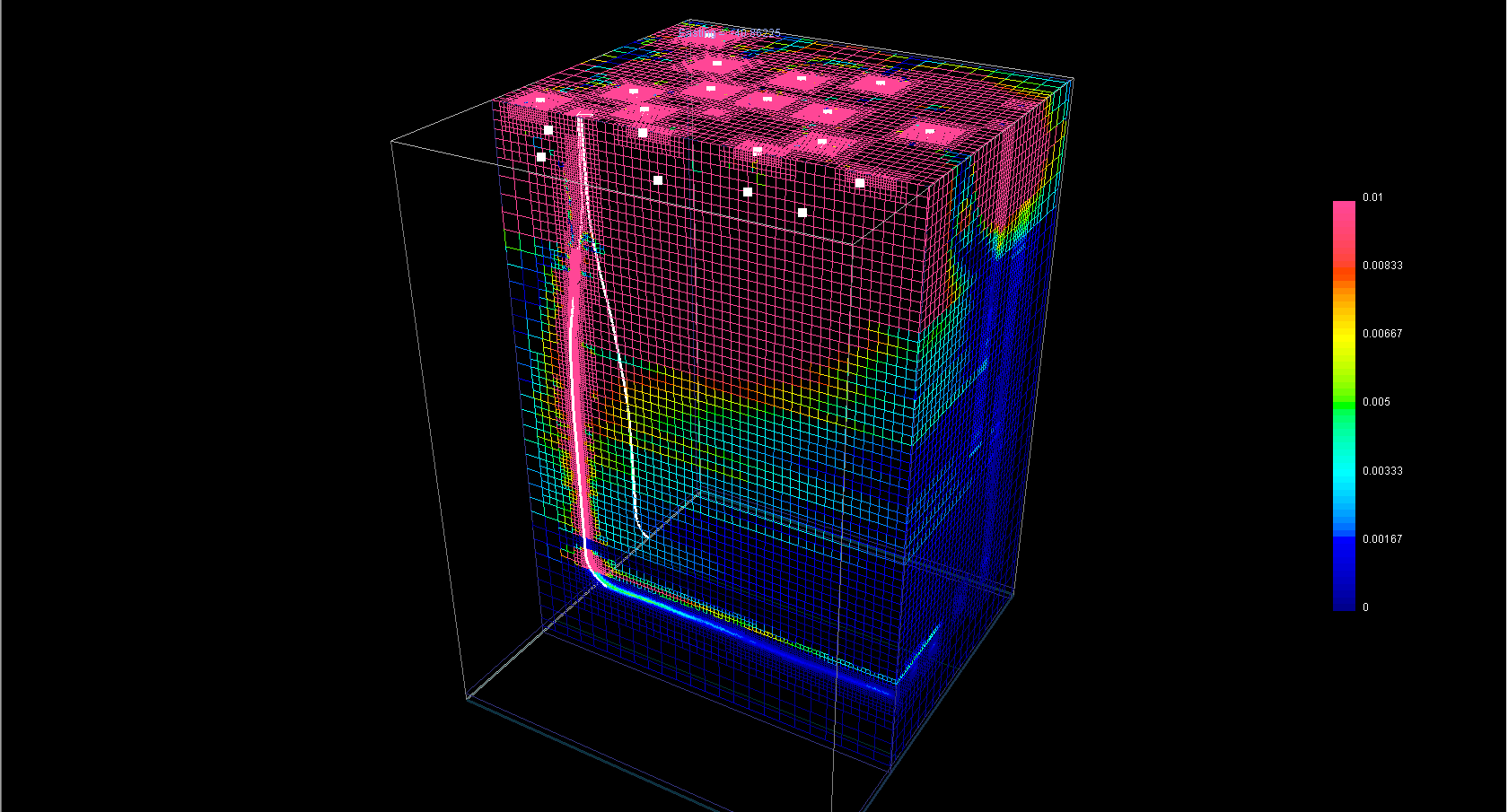
CGI’s advanced inversion technology was pivotal in handling complex environmental distortions, such as steel well casings and buried pipelines, which can otherwise dominate EM signals. By applying parametric inversions—approximating fractures as ellipsoids—the team resolved key attributes including fracture length, height, and width. Our approach also incorporated a specialized upscaling and homogenization method to capture the effects of extensive oilfield infrastructure.
The project introduced a semi-quantitative framework to assess the confidence of these geophysical inversions. By combining quantitative data misfit norms with qualitative "apriori" confidence (such as geological constraints and production data), we provided actionable cumulative distribution functions (CDFs) for fracture dimensions. This comprehensive uncertainty analysis empowers operators to make multi-million dollar business decisions regarding completion designs and well placement with a grounded understanding of subsurface risks.