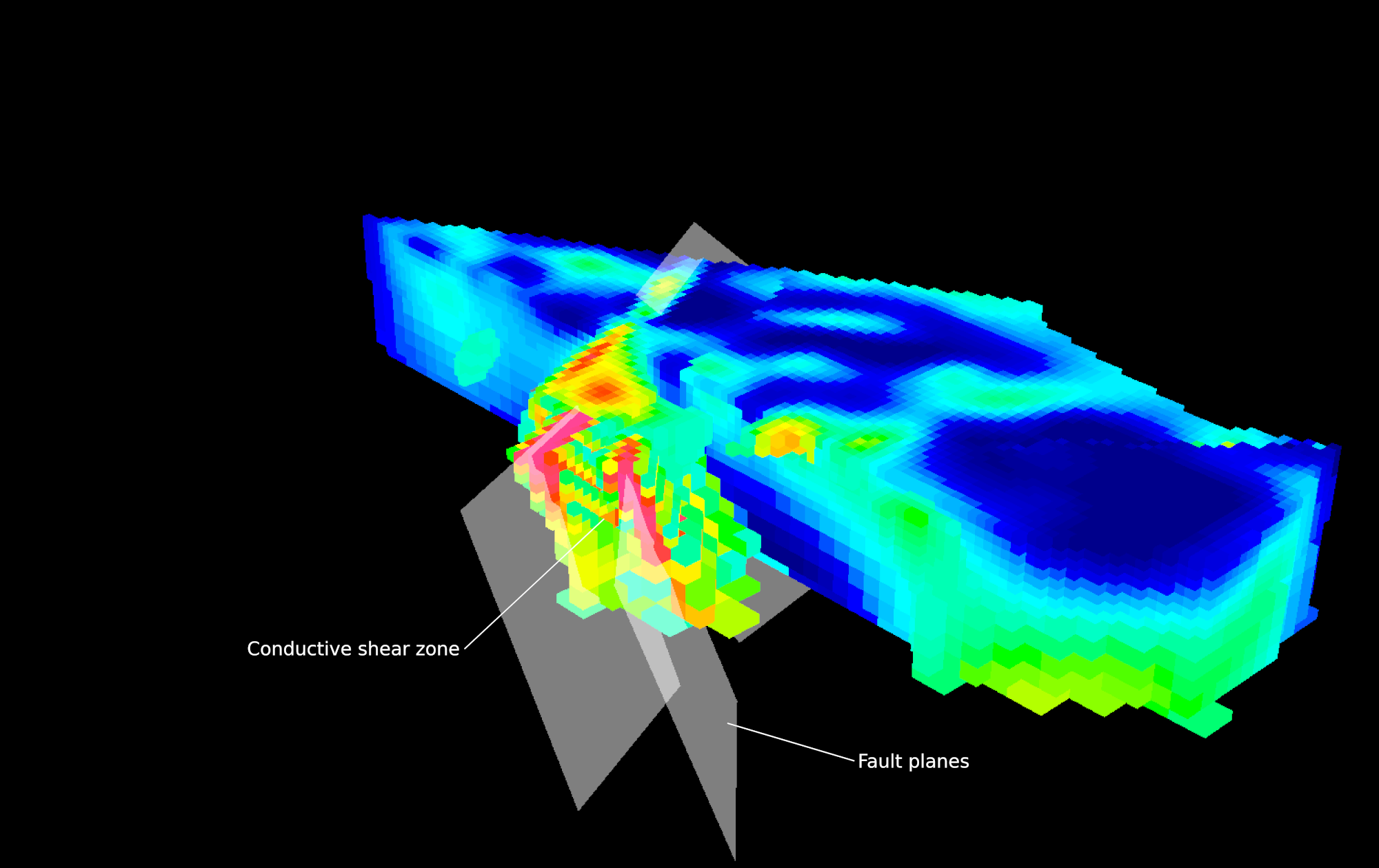
"At the Frotet project in Quebec, CGI's 3D inversion models were integral in imaging gold-bearing structures within sulphidized intrusive rocks that are completely concealed by glacial deposits and lakes. From their models, we were able to target small chargeable zones which ultimately led to the Regnault discovery in March, 2020."
Francis MacDonald
Executive Vice President of Exploration
Kenorland Minerals
Subsurface characterization demands more than single-dataset fitting. Our proprietary joint, constrained and multi-parameter inversion codes integrate diverse geophysical datasets into a single cohesive 3D model, simultaneously solving across multiple physical properties while applying geological constraints to eliminate implausible solutions. Built on adaptive octree meshes, our inversion minimizes a constrained optimization problem that balances data misfit against geologically-desirable model characteristics, delivering results that are both mathematically rigorous and physically meaningful.
Our team is skilled in developing bespoke workflows and codes for unique client needs, but our most frequently provided modelling services are:
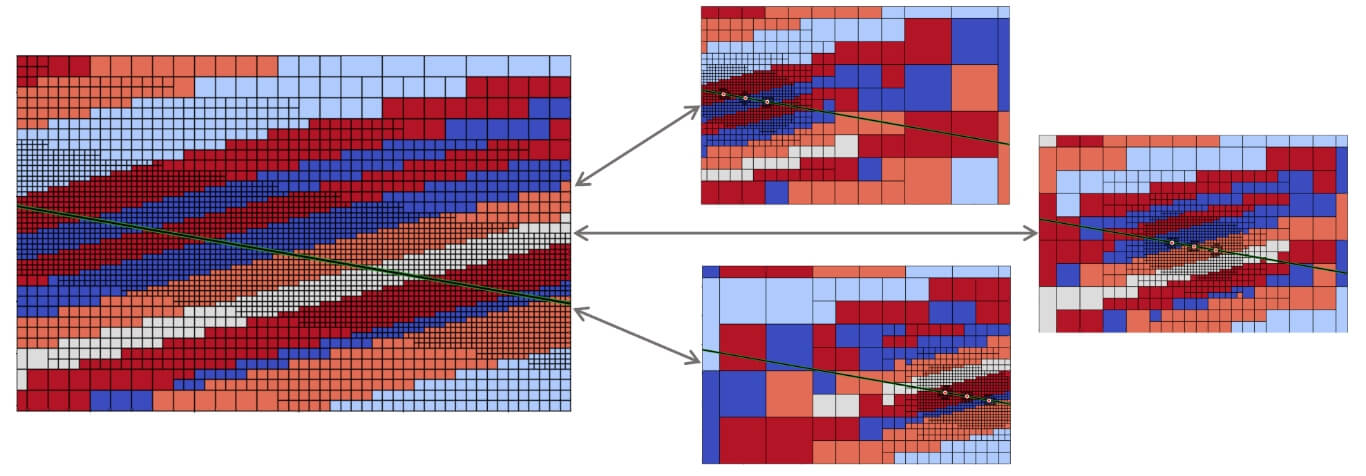
To capture meter-scale geological complexities across vast survey areas, traditional modeling often requires meshes with millions of uniform cells, creating a massive computational burden. We solve this by utilizing semi-structured, adaptive octree meshes. These meshes allow for local refinement—placing high-density cells only where necessary to capture detail, while maintaining a coarser structure elsewhere.
Using a staggered-grid, finite-volume discretization, our system stably handles high-contrast physical properties and complex survey configurations. This allows us to solve even the most demanding inverse problems efficiently, delivering high-resolution results using standard cloud or cluster computing resources.

CGI utilized advanced 3D inversion of DCIP data to identify high-priority gold and VMS targets within the Frotet-Evans Greenstone Belt.