Technology

GiLi - The world's first geophysically-informed 3D lithology modeller

"In brownfields exploration, the biggest risk is the geology you don’t see between the drill holes. At the Greenridge Carpenter project, GiLi represented a real step-change in how we addressed that uncertainty. It allowed us to rigorously integrate sparse but high-quality drillhole and mapping data with a large volume of airborne geophysics into a single, coherent framework."

Kyle Patterson
President, Convolutions Geoscience

Learns the core. Integrates geophysics. Models the Unknown.

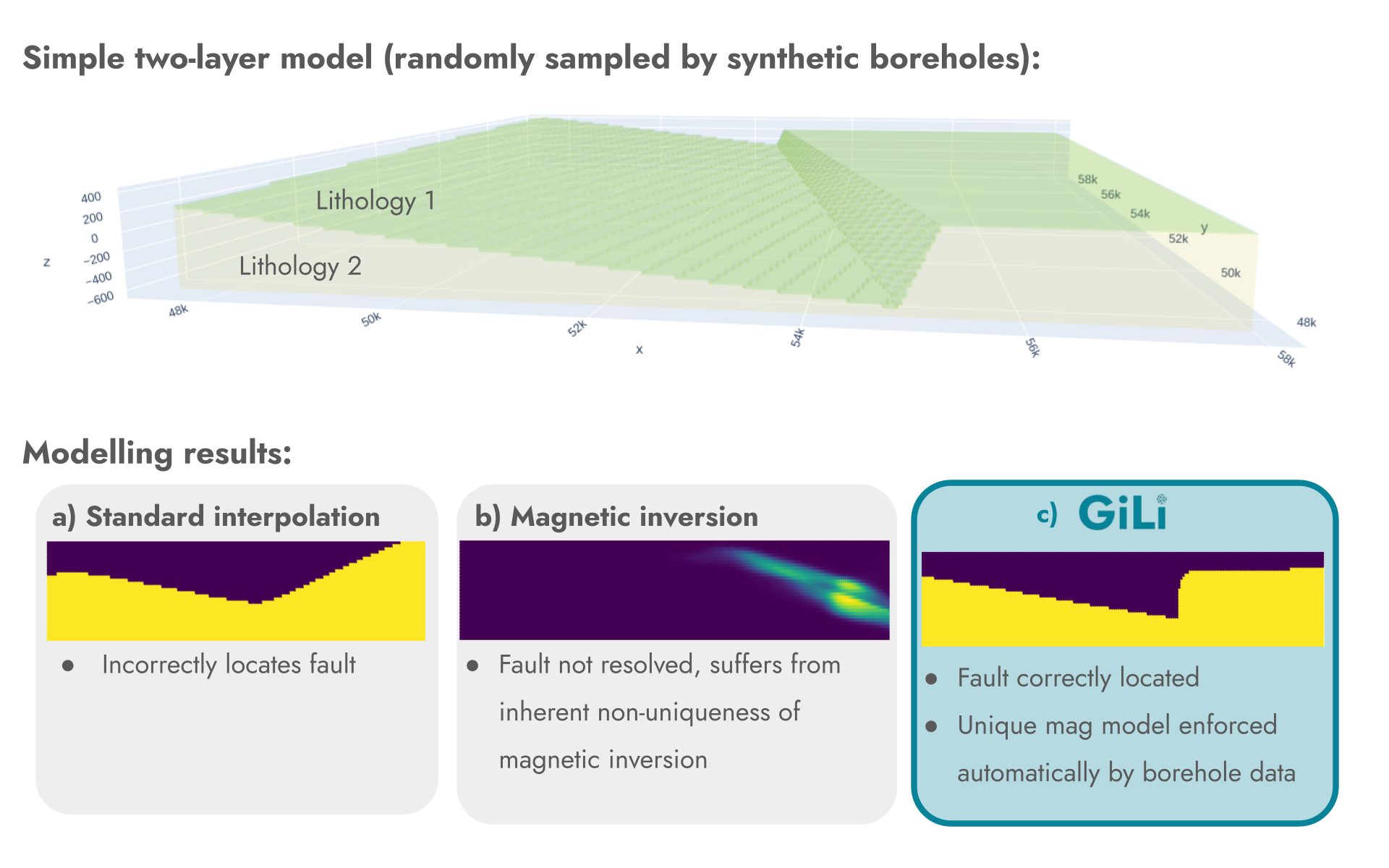
Traditional mineral exploration usually treats lithology modeling and geophysical inversion as separate processes. This disconnected approach can lead to models where borehole data and surface or airborne models are inconsistent. As a result, important features such as dipping layers or localized structures may be missed, especially when drilling is sparse.

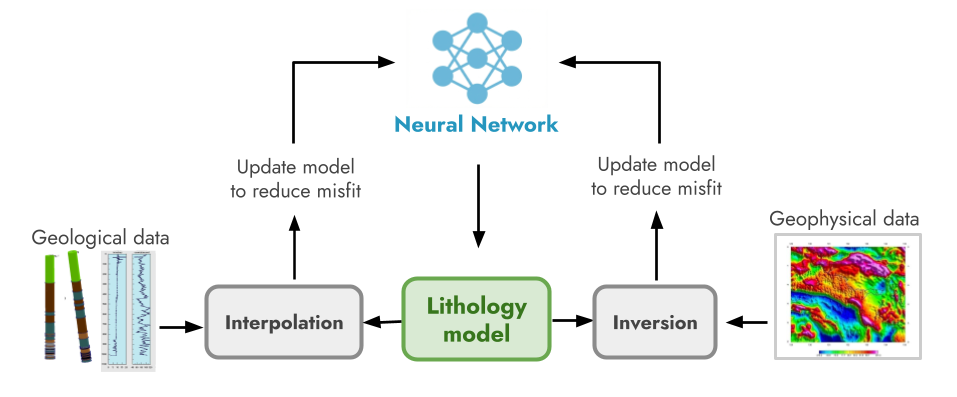
GiLi (Geophysically-informed Lithology Interpolation) addresses this gap by integrating lithology interpolation with geophysical inversion. It employs a neural network to create a 3D parameterization of the subsurface, using geophysical data to provide lateral guidance between drill holes. This approach ensures that the 3D models are physically consistent with all observed data simultaneously.

A joint-inversion solution to integrate geophysics and geology into a unified model

GiLi enables exploration teams to identify complex geological structures with greater confidence. By combining borehole data and geophysical surveys into a single, validated model space, the framework provides a more accurate basis for target generation and decreases the risk associated with limited drilling programs.

GiLi creates a 3D model of interpolated lithology that aligns with geological inputs and conforms to geophysical data. This approach integrates the spatial coverage of geophysical surveys with the granularity of in-situ measurements.

At Carpenter Lake, GiLi was utilized to integrate Greenridge Exploration’s historical geophysical data with available drilling data plus lithology and surface mapping, effectively resolving complex structures that traditional methods overlooked. By employing machine learning to create a cohesive 3D voxel model, steeply dipping conductors and low-density signatures were successfully mapped across 15 km of the Cable Bay Shear Zone.

Read More