Technology

Mineral Prospectivity Mapping

"The machine learning process is valuable because it removes bias, and its in-depth analysis of our extensive, high-quality data sets outreaches the capabilities of the human brain. The resulting targets have brought our exploration plans into focus and have given us confidence in our emerging discoveries at Aiviq and Kalulik. In addition, the machine learning identified new targets under shallow lakes and glacial-fluvial cover, where surface geochemical sampling has not been possible."

Michael Henrichsen
C.O.O. and Chief Geologist
Auryn Resources Ltd.

AI

Artificial Intelligence Solutions

When physical laws alone cannot bridge the gap between raw data and actionable insight, AI fills the void. At CGI, we leverage decades of real-world geoscience experience to deliver AI solutions built on rigorous data quality control and a rare fusion of domain expertise and machine learning depth.

Our pioneering VNet deep learning convolutional neural networks (CNNs) use a multi-resolution architecture to capture geo-spatial relationships across varied length scales and data types, learning subtle patterns that traditional methods miss. Complemented by capabilities in data augmentation, semi-supervised learning, and graph neural networks, these solutions are practically deployable at any stage of the discovery-to-closure mining lifecycle.

VNet: A New Prospectivity Mapping Approach

Taking Geosciences to the next level with AI and ML

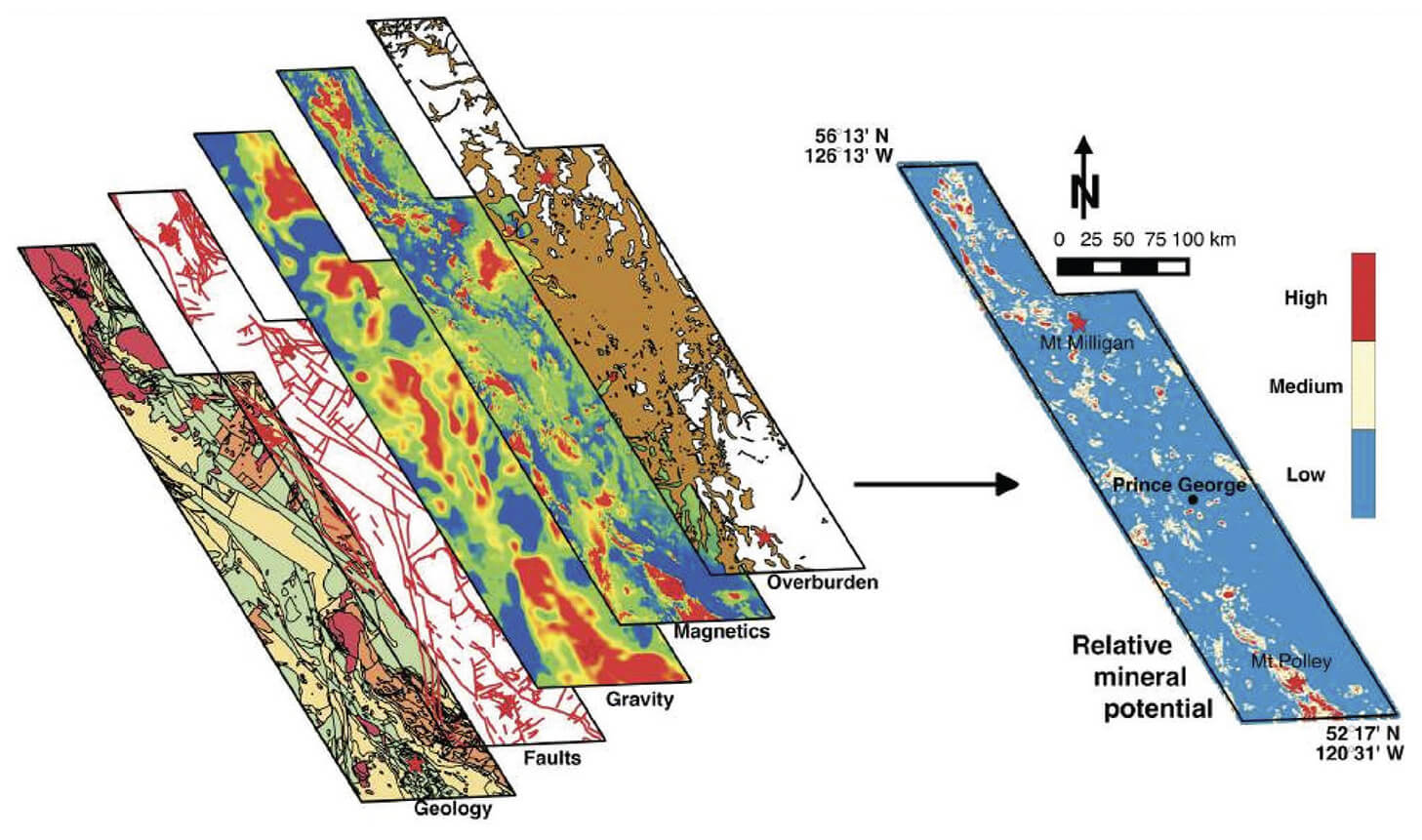
Traditional prospectivity algorithms like weighs of evidence, random forest, and self-oraginizing maps analyze data point-by-point, registering only a value at a single location while ignoring the broader spatial context around it. CGI's VNet CNN architecture was purpose-built to overcome this limitation. As a multi-resolution deep learning framework, VNet combines multiple geoscientific datasets as layered image channels and applies convolution operators across both spatial and inter-dataset dimensions simultaneously. This means it detects subtle patterns within individual datasets and across them, capturing the full spatial complexity of geoscientific data in a way that point-wise methods simply cannot, and delivering significantly more powerful and reliable prospectivity outputs.

CGI utilized its proprietary VNet deep learning algorithm to identify 12 new high-grade gold targets, including segments hidden beneath glacial cover and shallow lakes.

Read More